
What Are the Hidden Costs of Traditional Wood Framing?
By Brad Cooper • MC² Homes
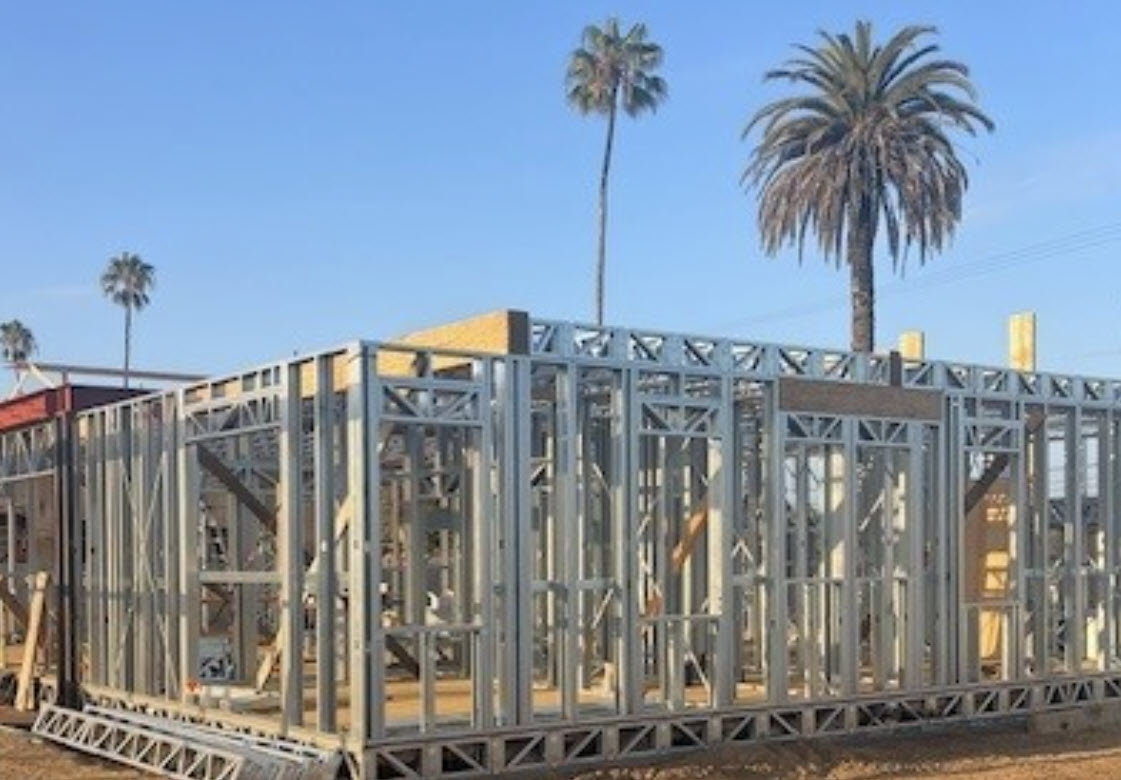
Cold-formed steel framing brings a manufactured, dimensionally stable approach to residential construction.
When homeowners compare wood framing with cold-formed steel, the comparison often starts with the obvious question: what does the material cost? But experienced builders know the framing invoice is only part of the real cost. The rest of the cost shows up in what happens to that material — and to the schedule — after it reaches the jobsite.
Waste Is a Cost
Wood framing requires pieces to be selected, cut, fitted and adjusted in the field. Some pieces are unsuitable. Some are cut incorrectly. Some are damaged. Some are left over. And sometimes a piece simply doesn't behave the way the builder expected.
Those costs rarely show up on a job-cost report under a line item called “hidden framing cost.” Instead, they show up as labor, material waste, additional purchases, schedule pressure and, in some cases, rework.
That distinction matters. A framing system should be judged not only by the price of the material that arrives on site, but by the amount of labor and uncertainty required to turn that material into a finished, accurate frame.
Movement Is a Cost
Wood is an organic material. Its moisture content changes, and with those changes wood can shrink, warp and twist.
That doesn't mean every wood-framed house develops problems — millions of good homes are built with wood. The issue is variability: the builder has to manage the characteristics of a natural material throughout construction.
For a builder, predictability has value. The more a framing system holds its intended dimensions, the less the construction process depends on field correction and interpretation.
Steel Changes the Equation
Cold-formed steel is manufactured to defined dimensions. FrameUpNow's current technical information describes its CFS components as manufactured to strict tolerances, with framing designed to remain dimensionally stable.
That changes the nature of the work. Instead of treating framing primarily as raw material to be selected and interpreted in the field, the builder can approach it as a precision-manufactured system.
The benefit isn't simply that steel is different from wood. The benefit is that a more controlled manufacturing process moves more of the precision work off the jobsite and into a defined, repeatable workflow.
“The question isn’t whether wood is bad. It isn’t. The question is whether residential construction can become more predictable.”
Brad's Experience Makes This Meaningful
This is where Brad Cooper's voice is particularly valuable. Brad isn't arguing that wood doesn't work. He's explaining why, after decades of construction experience, he believes there's value in a more predictable framing system.

Brad Cooper, MC² Homes
That perspective makes the argument more credible. The point isn't that one material is universally good and another universally bad. The point is that an experienced builder can evaluate a framing system by looking beyond the purchase price and asking what the system does to labor, waste, schedule, accuracy and rework.
The Better Question
The more useful question is not:
“Is wood bad?”
It isn't.
The better question is:
“Can residential construction become more predictable by moving more of the framing process from the jobsite into an engineered, digitally modeled and precision-manufactured workflow?”
FrameUpNow believes the answer is yes. MC² Homes is an example of a builder putting that philosophy into practice — and Brad Cooper is the person who can explain why. frameupnow.com
ABOUT BRAD COOPER
Brad Cooper brings decades of hands-on residential construction experience to the evaluation of new building systems. As the owner of MC² Homes in Arizona, he focuses on practical, purpose-driven construction and on finding ways to make the building process more predictable.