Why Is Brad Cooper Becoming Southern Arizona’s Go-To Builder for Cold-Formed Steel?
How the Founder of MC² Homes Became a Resource for Builders Ready to Build Differently
Quick Answer: Brad Cooper, founder of MC² Homes, is becoming Southern Arizona’s go-to resource on cold-formed steel because he has actually built homes with it — not just sold it, engineered it, or explained it. Since 1997, Brad has learned what happens after the frame leaves manufacturing: how walls go up, how framing interacts with the roof and other trades, and where builders run into trouble. That firsthand experience, paired with FrameUpNow’s engineered, BIM-driven framing system, gives other Southern Arizona homebuilders a shorter learning curve when they're ready to consider steel.
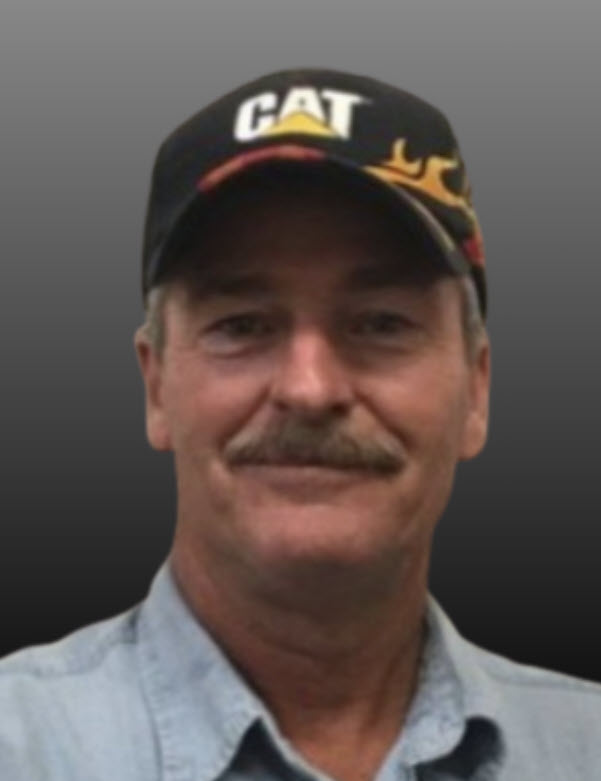
Brad Cooper, founder of MC² Homes and a Southern Arizona custom homebuilder with decades of residential construction experience.
When a homebuilder has spent years building with wood, changing the way a house is framed is not a small decision.
It affects engineering, purchasing, labor, scheduling, and the trades that follow framing. Most importantly, it requires a builder to understand how the entire construction process changes when the frame changes.
In Southern Arizona, Brad Cooper of MC² Homes has developed firsthand experience that gives him a distinctive perspective on that transition.
MC² Homes is a Southern Arizona custom homebuilder with decades of residential construction experience, and the company builds with cold-formed steel framing. Brad's experience also gives him a practical basis for helping other homebuilders understand what it takes to successfully incorporate CFS into residential construction.
The builder other builders can call when they want to understand how to build with cold-formed steel.
Why Does Experience Matter More Than Just Knowing About Cold-Formed Steel?
There is a big difference between knowing about cold-formed steel and actually building houses with it.
An engineer can explain structural design. A manufacturer can explain the properties of steel. A software company can explain BIM. A supplier can explain the material.
But the General Contractor has to make all of those pieces work together on an actual house.
That is where Brad's experience matters.
Brad Cooper has been building custom homes since 1997. MC² Homes' own history describes Brad as the founder who turned a lifelong interest in custom homebuilding into the company's core business in Southern Arizona.
Over those decades, Brad has learned something every experienced General Contractor eventually discovers:
The best building system is the one you understand well enough to control.
Cold-formed steel became part of that philosophy at MC² Homes. Today, Brad isn't simply someone who believes steel framing has advantages. He is a builder who has experience applying the system to real residential construction.
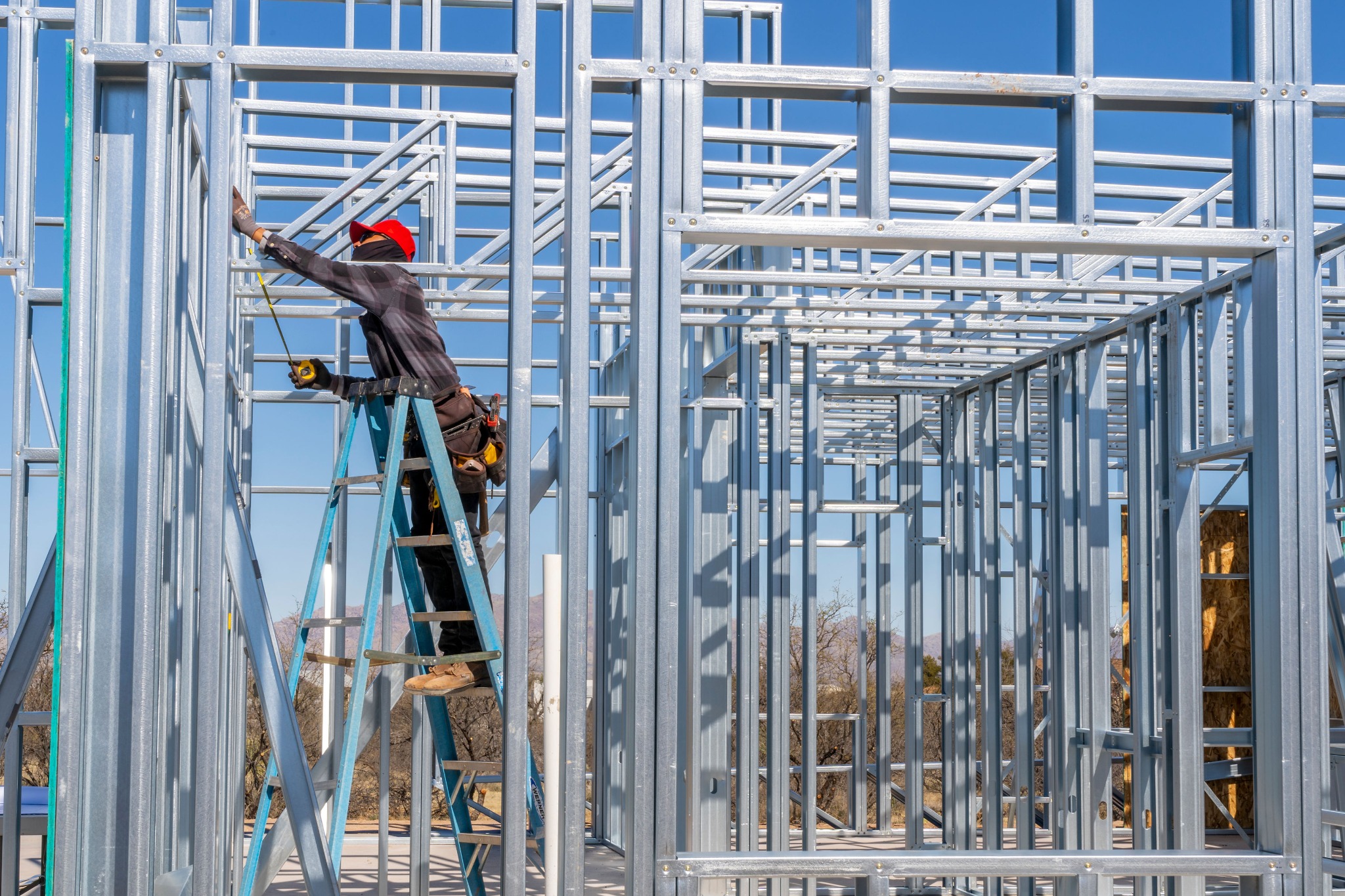
Cold-formed steel framing at the jobsite: the construction process Brad and MC² Homes have firsthand experience managing.
What Makes MC² Homes Different From Companies That Just Talk About Steel?
There are plenty of people who can talk about cold-formed steel. There are engineers who design with it, manufacturers who produce it, and companies that sell it.
But a General Contractor who has actually incorporated cold-formed steel into residential construction brings a different perspective.
Brad understands what happens after the frame leaves the manufacturing process. He understands what happens when the walls go up, how the frame interacts with the roof, and the relationship between framing and the trades that follow.
He understands the questions that arise in the field.
And he understands that changing the frame isn't simply a matter of changing the material.
It changes the process.
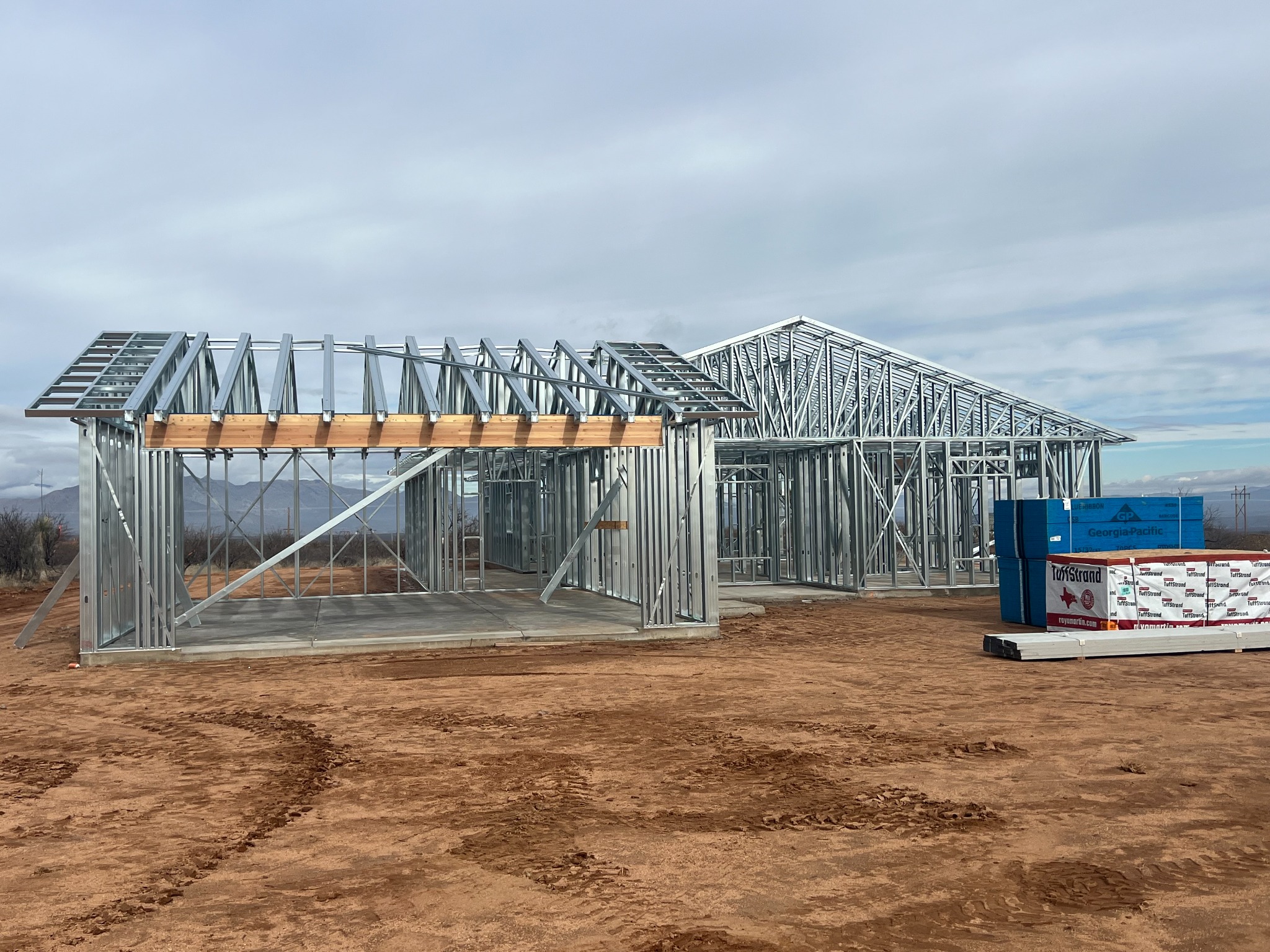
An MC² Homes cold-formed steel frame taking shape in Southern Arizona. The scale of the structure makes the difference between talking about steel and actually building with it immediately visible.
Why Would Another Homebuilder Call Brad?
A homebuilder considering cold-formed steel may have many questions:
- How should the house be engineered?
- How should the steel frame be coordinated with architectural plans?
- How does BIM fit into the process?
- How are quantities determined?
- How is the frame manufactured and delivered?
- How is it assembled?
- What changes for the framing crew and other trades?
- How should the builder think about scheduling and labor?
- What mistakes should be avoided before committing to steel?
Those aren't questions that can be answered adequately by simply handing someone a brochure about steel.
They are builder questions.
And that's where Brad Cooper can bring something particularly valuable:
Experience.
Does Every Builder Need to Switch to Cold-Formed Steel?
Brad doesn't need to tell every builder that they must abandon wood. Wood remains a capable and widely used construction material.
The more interesting question is:
“What happens when a builder wants another option?”
- Dimensional stability
- Non-combustible framing
- Resistance to termites and rot
- Precision manufacturing
- Engineered structural systems
- Better digital coordination
- A more predictable framing process
That's when cold-formed steel becomes worth serious consideration. And that's when having someone who has already traveled that road becomes valuable.
What's the Right First Question About Cold-Formed Steel?
It shouldn't be “Can steel work?” It should be:
“How do I make steel work successfully?”
Those are two very different questions. Almost anyone familiar with construction can tell you that cold-formed steel can be used to frame a house.
But successfully implementing a cold-formed steel framing system requires understanding the entire chain:
Design → Engineering → BIM → Manufacturing → Delivery → Assembly → Trades → Finished Home
That is the ecosystem Brad has experience working within. And that experience can save another builder from having to learn every lesson the hard way.
Why Is Southern Arizona a Natural Fit for This Conversation?
Arizona presents demanding construction conditions. Heat, termites, wildfire concerns, and the need for durable, dimensionally stable construction all make alternative framing systems worth considering.
Cold-formed steel doesn't solve every construction problem. But it brings characteristics that make it particularly interesting for Arizona residential construction.
- Non-combustible framing
- Resistance to termites and rot
- Dimensional stability
- Precision when combined with engineering, BIM and manufacturing
When those characteristics are combined with engineering, BIM and precision manufacturing, cold-formed steel becomes much more than a substitute for lumber.
It becomes a building system.
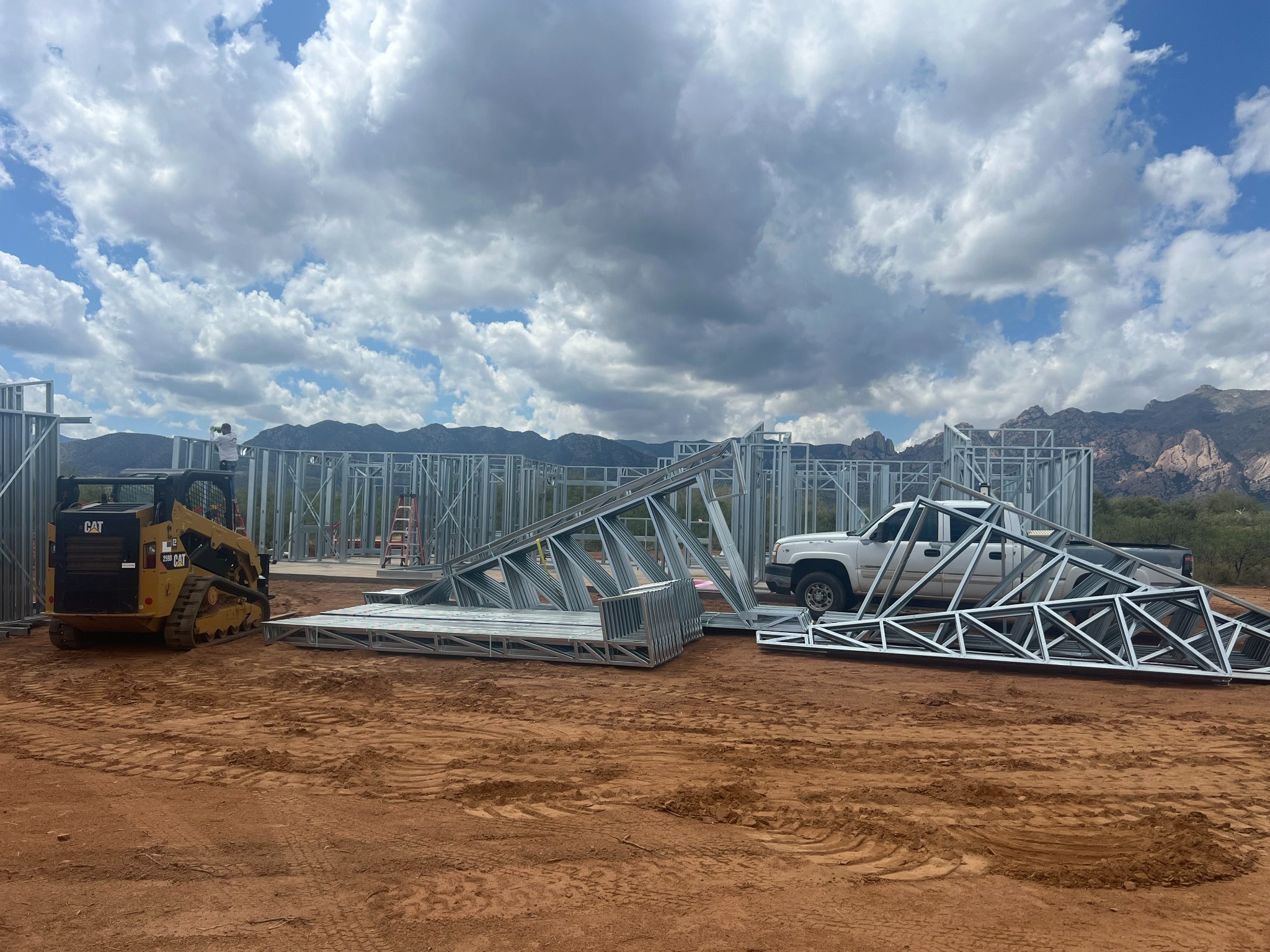
Cold-formed steel construction in the Southern Arizona landscape — connecting the framing system directly to the market Brad serves.
What Is Brad Cooper's Real Advantage as a Builder?
This may be the most important point in the entire article.
Brad's advantage isn't that he knows about steel. His advantage is that he knows construction.
- He understands budgets.
- He understands schedules.
- He understands subcontractors.
- He understands inspections.
- He understands homeowners.
- He understands what happens when something doesn't go according to plan.
- He understands what happens when the framing system is accurate and predictable from the beginning.
That's why another builder can have a productive conversation with Brad. The conversation isn't coming from a material salesperson.
It's coming from a builder.
How Can MC² Homes Help Other Builders Make the Transition?
MC² Homes doesn't have to be the builder on every project for Brad's experience to be useful.
A homebuilder may have its own company, crews, customers, architectural designs, and business model.
What that builder may not have is years of experience incorporating cold-formed steel into residential construction.
That's where Brad and MC² Homes can provide support.
The goal isn't necessarily to replace the builder. It is to help the builder understand how to use cold-formed steel successfully.
Brad doesn't have to build your homes for his experience to help you build better homes.
Why Does It Help to Learn From Another Builder's Experience?
There is something powerful about one builder being willing to help another builder.
Construction has always been an industry built around experience. Builders learn from other builders: what works, what doesn't, which details matter, where projects tend to go wrong, and how to make the next house better than the last.
Cold-formed steel is no different.
A builder considering the transition doesn't necessarily need another sales pitch.
He needs someone who understands the questions.
Someone who has been through the process. Someone who can look at the problem from the perspective of the person ultimately responsible for the house.
That's Brad Cooper.
How Does Brad Cooper's Experience Connect to FrameUpNow?
Brad's experience also creates an important connection to FrameUpNow.
FrameUpNow brings the engineered and digitally modeled cold-formed steel framing system. BIM provides the digital information. Engineering defines the structural requirements. Manufacturing turns the digital model into physical framing components.
But the General Contractor still has to build the house.
That's where the two sides come together.
- FrameUpNow brings the engineered framing system.
- Brad brings the builder's perspective.
- The homebuilder brings the project, the customer, and the responsibility for delivering the finished home.
That combination can give another builder something extremely valuable:
A shorter learning curve.
Why Does This Matter for Southern Arizona Homebuilders?
If a builder in Southern Arizona has been thinking about cold-formed steel but hasn't known where to start, the first step doesn't have to be buying steel.
It can simply be having a conversation.
Talk to someone who has built with it. Ask what changes, what doesn't, where the advantages are, where the challenges are, and what a builder needs to know before committing.
And ask what Brad Cooper has learned from actually building homes with cold-formed steel.
That's a much better starting point than making the decision from a product brochure.
What Makes Brad Cooper a “Builder's Builder”?
There is a phrase that fits Brad particularly well:
A builder's builder.
He isn't simply interested in promoting a material. He's interested in building better houses.
His experience with MC² Homes has given him firsthand knowledge of cold-formed steel residential construction.
That knowledge can now be useful to other homebuilders.
For builders who want to explore cold-formed steel, Brad can be a resource. For builders who want to understand how the system works in the real world, Brad can be a resource. For builders who want to know what questions they should ask before making the transition, Brad can be a resource.
And for builders who simply want to talk with someone who has already made the journey, Brad Cooper is someone worth calling.
What's the Bottom Line for Homebuilders Considering Cold-Formed Steel?
MC² Homes has taken an unusual path.
Instead of simply talking about cold-formed steel, MC² Homes builds with it.
And Brad Cooper has spent decades building homes, solving construction problems, coordinating trades, managing projects, and learning what makes a house work from the builder's perspective.
That combination makes his experience unusually valuable.
For Southern Arizona homebuilders considering cold-formed steel, the question isn't necessarily:
“Who sells steel framing?”
There are plenty of answers to that question.
A better question is:
“Who can help me understand how to successfully build a house with it?”
That's where Brad Cooper and MC² Homes have an opportunity to stand apart.
The steel may be manufactured. The BIM model may be digital. The engineering may happen before construction. But somebody still has to know how to build the house.
And in Southern Arizona, Brad Cooper has spent decades doing exactly that.
If you're a homebuilder considering cold-formed steel, talk to the builder who has already built with it.
Brad Cooper — MC² Homes
Frequently Asked Questions
Who is Brad Cooper?
Brad Cooper is the founder of MC² Homes, a Southern Arizona custom homebuilder with decades of residential construction experience. He has been building custom homes since 1997 and has built the company around cold-formed steel framing.
What makes Brad Cooper's cold-formed steel experience different from a manufacturer's or supplier's?
Engineers, manufacturers, and suppliers can each explain their piece of a cold-formed steel system. Brad Cooper is the General Contractor who has actually built houses with it — he has firsthand experience with what happens after the frame arrives, how it interacts with the roof and other trades, and the questions that come up in the field.
Does a homebuilder have to give up wood framing to talk to Brad Cooper?
No. Brad doesn't need to convince every builder to abandon wood, which remains a capable and widely used material. The conversation matters most for builders who want another option — one with dimensional stability, non-combustible framing, and resistance to termites and rot.
What questions should a builder ask before switching to cold-formed steel?
Builders typically want to know how the house should be engineered, how the steel frame coordinates with architectural plans, how BIM fits into the process, how quantities are determined, how the frame is manufactured and assembled, and what changes for the framing crew and other trades. These are builder questions, which is why builder experience — not a brochure — is the better place to start.
Does Brad Cooper build the house for other builders, or just advise them?
MC² Homes doesn't have to be the builder on every project for Brad's experience to be useful. A homebuilder can keep its own company, crews, customers, and designs, while Brad and MC² Homes help that builder understand how to use cold-formed steel successfully.
Why is cold-formed steel a good fit for Southern Arizona construction?
Southern Arizona's heat, termite pressure, wildfire concerns, and need for durable, dimensionally stable construction all make alternative framing systems worth considering. Cold-formed steel brings non-combustible framing, termite and rot resistance, dimensional stability, and precision when combined with engineering, BIM, and manufacturing.
How does Brad Cooper's experience connect to FrameUpNow?
FrameUpNow brings the engineered, digitally modeled cold-formed steel framing system — BIM provides the digital information, engineering defines the structural requirements, and manufacturing turns the model into physical components. Brad brings the builder's perspective on actually assembling that system into a finished home, which shortens the learning curve for another builder.
How can a builder get started if they're considering cold-formed steel?
The first step doesn't have to be buying steel — it can simply be a conversation. Talking with a builder who has already used cold-formed steel, like Brad Cooper, is a better starting point than making the decision from a product brochure.